
The Ghosts We Chase
Do you feel it?
That soft vibration—almost imperceptible—a chill that creeps up your spine, as if a drop of water from some frozen tundra is running against gravity, vertebra by vertebra. A Cold hand’s fingers reaching out, wrapping around you, leaving you suspended between being swaddled and suffocated. Do you notice the hairs rising? The heaviness in your throat, the relentless tide behind your eyes, as if your body is its own cistern, brimming and ready to spill.
I do.
One of my favorite books is A River Runs Through It by Norman Maclean. He writes:
“Eventually, all things merge into one, and a river runs through it. The river was cut by the world's great flood and runs over rocks from the basement of time. On some of the rocks are timeless raindrops. Under the rocks are the words, and some of the words are theirs, and I am haunted by the waters.”
I can’t say exactly why this book is my favorite. It has been since I discovered it a some years after the movie was released in 1992. Maybe it’s because I fished with my brother and father, from childhood into adulthood. Maybe it’s the romanticism of the untamed West, the clean, untarnished streams where you could be alone with the symphony of time (did you know there’s no direct synonym for “time”?). Or maybe it’s something deeper—a learning that isn’t spoken, but felt. Recently, I learned not everyone has an inner voice narrating their thoughts. Some people think in images, a living CAD system in place of words. Others learn through sensation, through the textures and sounds of the world. If I had to name the mechanism by which this book became my favorite, I’d say it’s emotional and reflective learning. I can’t tell you why I love it—it’s not a dialogue, it’s a feeling. I feel it, like I feel my own story, written on whatever mystery lies beneath those rocks and raindrops Norman speaks of.
I’ve called this book my favorite for decades, but there was always a line that didn’t sit right with me: “Under the rocks are the words, and some of the words are theirs.” Why “theirs,” not “ours”? And why is he haunted by them? They felt right, even as they conflicted with my minds’ own version of a debate, but phonetically speaking, they didn’t.
Only recently did I begin to understand—and that understanding came not from logic, but from feeling. For I believe that a word that is written beneath those rocks, must be “wisdom”.
Dr. Masaru Emoto—a New York Times best-selling author—explored this idea in his book, The Hidden Messages in Water. He claimed that water molecules could be shaped by our words—kindness making them beautiful, cruelty making them chaotic. While his work is often labeled pseudoscience, recent research at MIT has begun to explore similar territory. Using high-speed cameras, MIT scientists have observed that sound waves create minuscule vibrations—ripples—on the surfaces of objects. With advanced algorithms, they’ve even been able to “play back” the sounds that caused those vibrations, essentially retrieving echoes from inanimate things. What if our words, our presence, really do leave echoes? What if the world remembers us in ways we’re only beginning to understand?
So I ask again: Do you feel it too?
This isn’t a review of Norman’s book, I promise. The story I want to review is “ours.” I recently returned home—a word that’s always been ambiguous for me. My family moved often; home was never just a place, but a collection of constants: people, memories, a few fixed points on a map. I had a lot of homes, my parents worked hard at creating consistent spaces for us despite our nomad tendencies.

The family called it “Shangri-La”—a name passed down through generations. It’s nestled in the middle of a rolling Appalachian valley, bookended by forests and orchards, a stream running through its center, its headwaters formed from natural springs on the property. Either hillside offers an unabated view across the entire region—rolling hills, fields, and forests as far as the eye can see, speckled with distant homesteads and weathered barns. Each morning, the sun almost perfectly rises over the property’s southeast shoulder, immediately kissing the cool fog that always rests in the valley, lighting it up with a passionate fury of red, orange, and amber. The dark, bracing night gives way, and the life on the farm becomes visible—birds calling, chickens waking up, the turkeys moving into the fields to feed…. the world waking up.
But wisdom tells me beauty isn’t why I call it, or any of these fixed places in my memories, home. It was the people and the memories on it that did. So many blessed memories— should we reference such as “memories”? Perhaps it would be better to call it not “memories” but “memory” as a single, winding river, continuously flowing and building upon itself, each new experience influencing both the past and future. Isn’t that what home is? Not just a place, but the sum of all that has happened there—the laughter, the loss, the ghosts we leave behind.
Do you feel it yet?
I still feel the burning sensation on my heels as the rubber from my hand-me-down waders would abrade me—a reminder that I had yet to fill my brother’s shoes—as we walked five miles up the old logging road to our favorite spot on Middle Fork Creek. A peaceful stroll through forests and prairies, the stream making Hollywood like appearances as it would wind from the mystery of the woods down across the road, only to disappear again. I feel the chill of the waters leaking through worn patches, a relic of generational feet in these same boots. As a pre-teen, I wore them anyway—they made me feel like one of the men.
Another foundational home for me was a small A-frame hidden under a thick grove of sound-damping hemlocks, hugged on three sides by a creek. In the middle of the Appalachian National Forest, this place was an adventurer’s dream. Forests to explore for what seemed like an impossible and unending distance. Ferns grew atop the spongy pine-needle-covered floor and the canopy sang with birds and a chorus of leaves conducted by wind and sometimes rain. During the hottest part of the day, the cool creeks felt like paradise; in the evenings, the mountains and forest delivered a night that begged for your comfiest hoodie and a fire. A clear, rich night sky that resembled the world’s biggest Lite Brite, framed in the dancing flames’ projection onto the untouched canopy above. The light show was supported by a soundtrack: the sound of water rushing over the rocks of time and conversations around the fire.
When I walk the areas streams and creeks today, from the banks I swear I can still smell the charcoal from my father making lunch for my brother and I. Stopping at an aged bridge at the farthest stretch of the road and I look to the water, where I see my brother in it’s reflecting waters, me next to him.
Much like the farm, it was home because of the people and my memory.
Clichés are such for a reason—there’s truth in them. Lyrics like “Someone to come home too..” in Teddy Swims’ song “All That Matters” or towels hanging from an oven handle that say “Home is where the soup is”—they aren’t wrong. But are they complete?
It is not lost on me that Wisdom changes with time. Today, it tells me why Norman wrote “theirs” instead of “ours” like I had felt it should have been…..and I think I know why those words haunted him.
The collective memory that defines home isn’t just the landscape—but it isn’t not the landscape, either. When I put my hands in the cold stream, I see shadows of my grandfather, ghosts of my father and brother. When I walk the dirt logging road, I see even more ghosts—some of them me, but not me. I find myself often following these ghosts, stalking them in these places, matching their footsteps, pausing to glimpse a former self behind a barn door or at the top of the stairs where cousins, siblings and I played. I see us trying to guess which hand the penny was in during our ultimate childhood game, or arguing over whether or not someone looked at the value of a painting unfairly in the game Masterpiece. I smell grapefruit in the small kitchen where my grandmother would peel them, a spot where she could see the sunrise I spoke of earlier, a perfect view through the kitchen window. I could go on—not just about home, but about everything: work, my mother, dear friends, my sister, school, marriage, the loss of two babies that never were. There are roads I still avoid because of the ghosts I see there as a result of my time on the ambulance. There are memories I run away from because the ghost of my former self isn’t one I wish to ever see again.
What if Dr. Emoto was on to something and MIT is making it observable. Maybe even scripture was telling us about it all along too, reference Luke. I think this means that our impact on each other, on this world, is far more powerful than we ever imagined. I think the spaces in which we exist feel us and we leave echos that can very much be perceived. Like a boat passing by the shore, its waves crashing the shoreline long after its gone, a remenat of what was, a calling card perhaps that says, screams and maybe even pleads, “I WAS HERE”! I wonder what remnants you are leaving for the world?
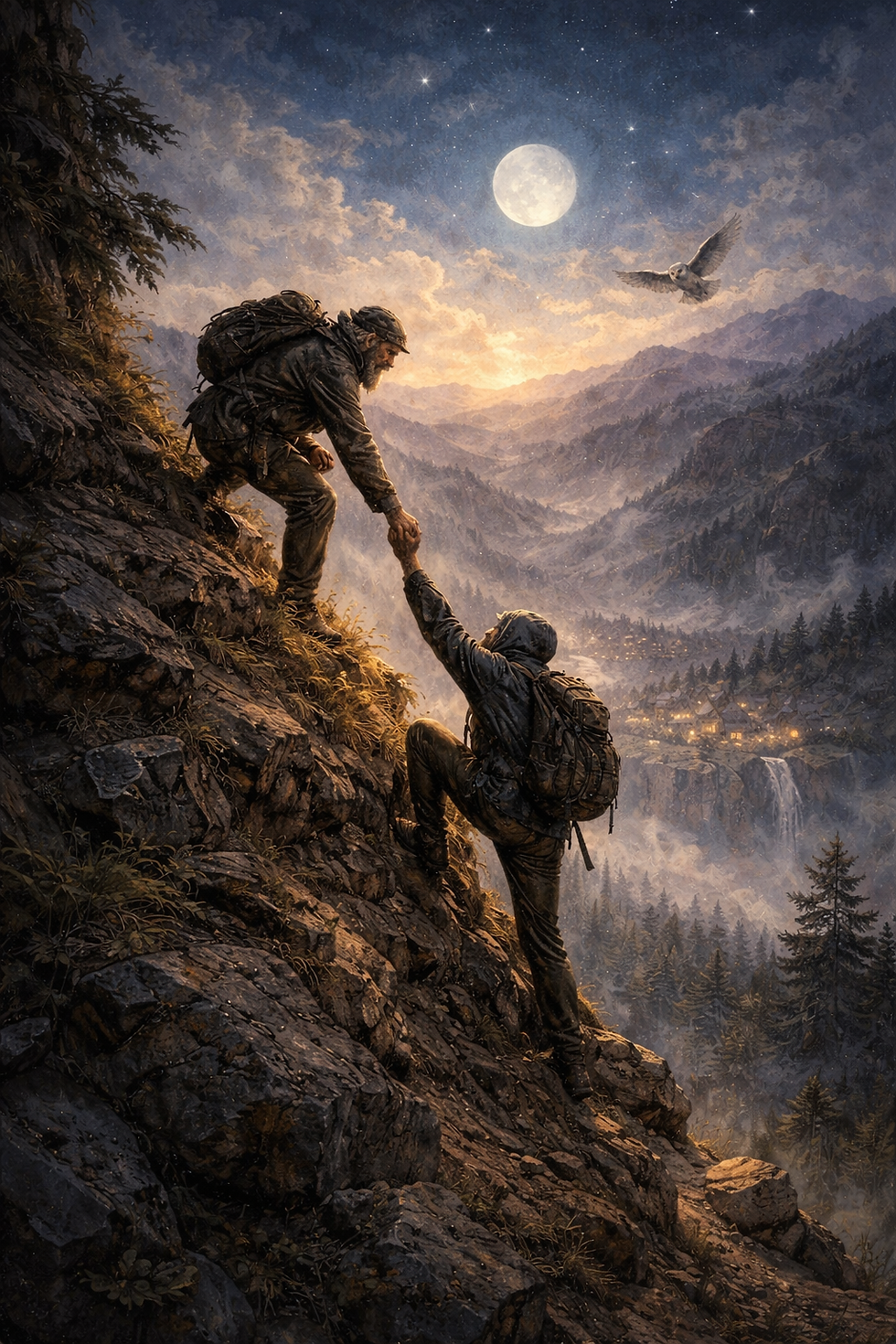
The ghosts that haunted Norman weren’t his anymore. Just like the ones I see and feel when I chase the creek’s raindrops upstream. They were me, until time passed, took them and wrote them on the basement of time. Each moment is a raindrop, a contribution perhaps, maybe a gift as well? Most certainly. One that we create and immediately give away, like a ripple impacting everyone and everything around us. The words belong to them now, creating ghosts in the waters.
And the waters haunt me.
By The Ghost of Nathaniel Metz


Comments